

Walk down the supplements aisle of any UK pharmacy or search "testosterone booster" online and you'll find dozens of products promising more energy, more muscle and a stronger libido. The marketing is confident. The evidence behind most of it is not. This guide sets out what testosterone boosters actually contain, what the clinical trial evidence says about whether they raise testosterone, the one genuine exception worth knowing about, and when the right move is a blood test rather than another bottle of capsules.
What testosterone boosters claim to do
"Testosterone booster" is a marketing term, not a regulated medical category. In the UK, products sold as testosterone boosters are regulated as food supplements, not as medicines, and none of them is licensed to diagnose, treat or prevent low testosterone. That distinction matters: a licensed medicine has been through clinical trials assessed by the MHRA for safety and effectiveness for a specific use, while a food supplement only has to be safe to consume at the stated dose. Nobody independently checks whether it does what the label implies.
Most testosterone boosters contain some combination of a handful of recurring ingredients: D-aspartic acid, tribulus terrestris, fenugreek extract, ashwagandha, zinc, vitamin D and sometimes boron or magnesium. The marketing copy usually leans on language like "naturally boosts", "supports healthy levels" or "clinically studied ingredient", phrasing designed to imply a hormonal effect without making a claim precise enough to need proof. It's worth reading that language carefully, because "supports" and "boosts" are doing a lot of work to avoid saying "raises your testosterone", which is the claim an actual trial would need to demonstrate.
What the trials actually show
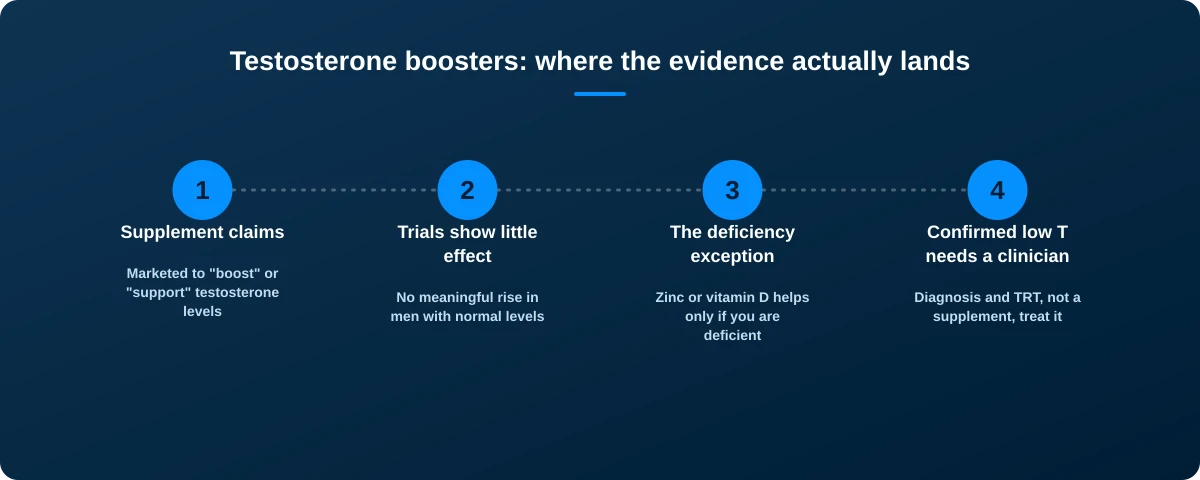
When the individual ingredients are tested properly, in randomised trials against a placebo, the picture is consistently underwhelming for men who already have a normal testosterone level. D-aspartic acid, despite being one of the most heavily marketed ingredients in this category, has not shown a consistent or meaningful rise in testosterone across controlled studies in healthy men. Tribulus terrestris performs similarly: trial results are mixed at best, and the better-designed, placebo-controlled studies tend to show no significant difference from placebo. Fenugreek extract has shown modest changes in some small studies, usually in measures like strength or libido rather than a clinically meaningful rise in total testosterone itself, and the evidence base remains thin.
Ashwagandha is one of the more actively studied adaptogens in this space, and some trials report a modest increase in testosterone, particularly in men under stress or with low baseline fertility markers. Even so, the effect sizes are small, study quality varies considerably, and it falls well short of the kind of result that would support a genuine clinical claim. None of this amounts to evidence that any over-the-counter supplement can meaningfully raise testosterone in a man whose level is already within the normal range, which is the situation most people buying these products are actually in.
Zinc, vitamin D and the deficiency exception
There is one genuine exception worth taking seriously, and it's easy to misread as support for the whole category. Zinc and vitamin D both play a real role in testosterone production, and in men who are actually deficient in either, correcting that deficiency can help restore testosterone towards a normal level. This is well established and clinically sensible.
The catch is the word "deficient". If your zinc and vitamin D levels are already adequate, which is the case for most men eating a varied UK diet, topping up further with a supplement produces no additional rise in testosterone. The deficiency-correction effect is real, but it's not a general testosterone-boosting effect, and marketing that blurs the two is misleading. If you suspect you might be low in either, a blood test can confirm it, and a targeted, appropriately dosed supplement for that specific deficiency is a reasonable, evidence-based step, quite different from an untargeted "booster" blend hoping one of its ingredients happens to apply to you.
Safety: adulterated products and MHRA warnings
Beyond simply not working, some testosterone boosters carry a real safety risk. The Medicines and Healthcare products Regulatory Agency (MHRA) has warned about supplements, often sold through online marketplaces rather than established UK pharmacies, that were found to contain undeclared pharmaceutical ingredients, including unlicensed anabolic substances not listed anywhere on the label. Because food supplements don't go through the same premarket safety review as medicines, a product can reach a UK buyer's door with contents that bear little resemblance to what's printed on the packaging.
This is also where self-sourced testosterone itself, rather than a supplement, becomes a genuine danger: testosterone is a prescription-only medicine in the UK, and any product supplying it without a prescription, blood tests or clinical oversight sits entirely outside the regulated system. Sticking to reputable, UK-based retailers for any supplement, and being wary of extravagant claims or unusually cheap prices for "fast-acting" products, meaningfully reduces this risk, though it doesn't change the underlying evidence problem covered above.
Why boosters cannot treat low testosterone
Confirmed low testosterone, or hypogonadism, is diagnosed on two separate early-morning blood tests showing a level below the normal range, alongside symptoms that fit the picture. Testosterone replacement therapy (TRT) is a prescription-only medicine, available as gels, injections or implants, and it works by directly replacing the hormone the body isn't producing enough of. Our guide to how TRT works covers the formulations and monitoring involved in more detail.
A food supplement cannot replicate that mechanism. Even the ingredients with the most supportive evidence, such as correcting a genuine zinc or vitamin D deficiency, only restore testosterone as far as removing that specific deficiency allows; they cannot push a confirmed hypogonadal level back into the normal range the way a prescribed, monitored dose of testosterone can. Treating confirmed low testosterone with an over-the-counter supplement risks leaving a genuine, treatable medical condition unaddressed while symptoms continue to affect day-to-day life.
When to test instead of supplement
If you've been reaching for a testosterone booster because of fatigue, low libido, low mood, reduced muscle mass or difficulty concentrating, the more useful next step is usually a blood test rather than a supplement. Our guide to low testosterone symptoms and who should test sets out exactly which symptoms warrant arranging one, and who is more likely to have a genuinely low level worth investigating, such as men with obesity, type 2 diabetes or a history of testicular problems.
Testing is straightforward: an early-morning total testosterone reading, repeated on a second morning if the first comes back low, usually alongside LH, FSH and SHBG to help establish the cause. If your result is genuinely low, a clinician can discuss whether TRT is appropriate for you, based on your symptoms and full clinical picture, not on guesswork from a supplement label. And if your level turns out to be normal, that's useful information too: it means your symptoms likely have a different, non-hormonal explanation that's worth exploring properly, rather than being quietly papered over with another bottle of capsules. Either way, you'll know what you're actually dealing with, which a supplement, by its nature, can never tell you.