

What is Foundayo (orforglipron)?
Foundayo is the brand name for orforglipron, a new once-daily tablet for weight management and type 2 diabetes developed by Eli Lilly. On 10 August 2026 the MHRA (the UK's medicines regulator) authorised it for use in the UK, the first approval anywhere in Europe, following the US approval in April 2026.
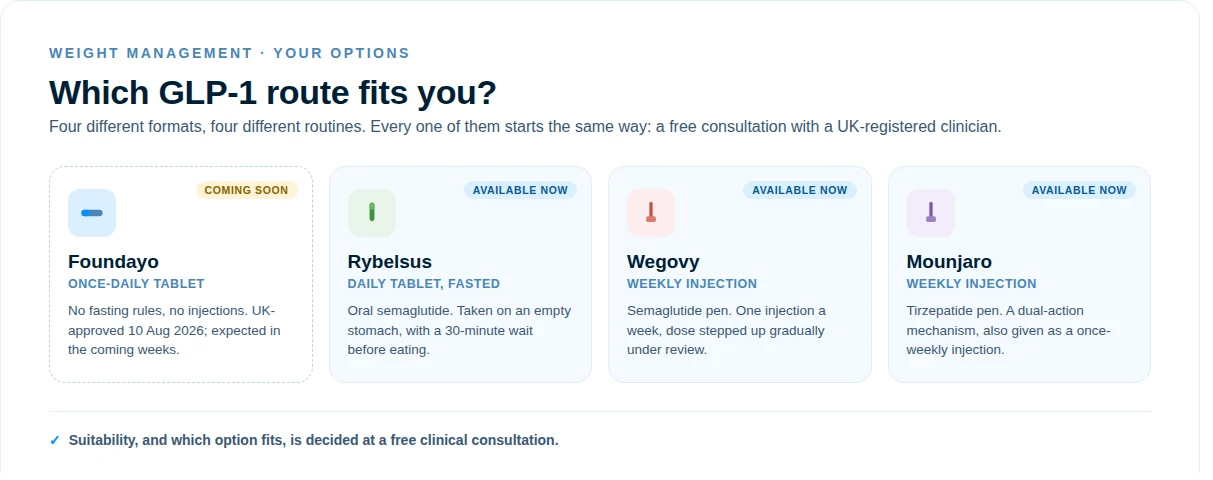
What makes it notable is the format. The GLP-1 medicines most people have heard of, Wegovy and Mounjaro, are weekly injections. Orforglipron is the first small-molecule GLP-1 receptor agonist: a conventional tablet rather than a peptide, which is why it can be taken like an ordinary daily medicine.
How does orforglipron work?
Orforglipron works the same way as other GLP-1 receptor agonists. It mimics GLP-1, a natural gut hormone released after eating, which acts on appetite centres in the brain, slows how quickly the stomach empties, and helps the pancreas release insulin when blood sugar rises. The practical effect is feeling satisfied with less food, fewer cravings, and steadier blood-glucose levels.
If you want the deeper mechanism, our guide to how GLP-1 receptor agonists work covers it in detail: everything there applies to orforglipron too, only the delivery method is new.
What makes it different from other GLP-1 treatments?
Two things: it is a tablet, and it is an unusually convenient one.
A daily oral GLP-1 already exists, oral semaglutide (Rybelsus), but because semaglutide is a peptide that stomach acid breaks down, it comes with strict rules: taken on an empty stomach when you wake, with only a few sips of water, then nothing to eat or drink for at least 30 minutes. Many people find that routine hard to keep up.
Because orforglipron is not a peptide, none of that applies. Foundayo can be taken at any time of day, with or without food, and with no water restrictions. For people who are put off by injections, or who struggle with the fasting routine of existing tablets, that removes the two most common practical barriers to GLP-1 treatment. Our comparison of the Wegovy pill versus the injection explains why these routine details matter more than they sound.
Who is Foundayo licensed for?
The UK licence covers two groups of adults:
- Weight management: adults with a BMI of 30 or above, or a BMI between 27 and 30 alongside at least one weight-related health condition such as high blood pressure, high cholesterol or obstructive sleep apnoea, always alongside diet and physical activity.
- Type 2 diabetes: adults whose blood glucose is not adequately controlled on their current treatment.
A licence describes who a medicine can be prescribed for, not who it should be. Suitability still depends on your full health picture, including other conditions, medicines you take, and your history, which is why an individual clinical assessment comes first.
The six strengths and how dosing works
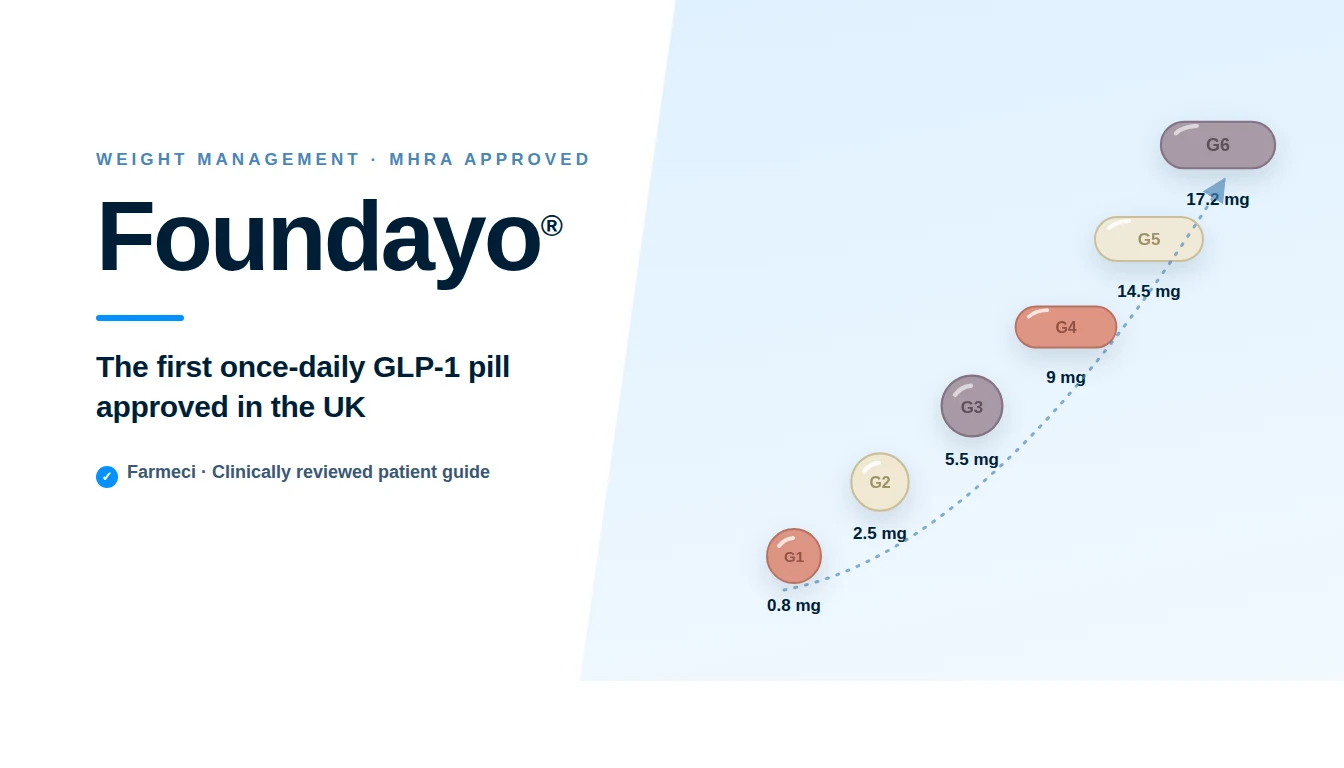
Foundayo is licensed in six strengths of once-daily film-coated tablet, supplied in packs of 30. The three lower strengths are small round tablets and the three higher strengths are larger ovals; each carries its own debossed code (G1 to G6), and every carton is colour-coded to its strength, a small design detail that makes mix-ups between titration steps much less likely in practice.
Dosing follows the titration pattern familiar from the injectable GLP-1 medicines: treatment starts at the lowest strength and is stepped up at intervals set by your prescriber, giving the body time to adjust at each stage. Where you settle on the ladder depends on how you respond and how well you tolerate each step; not everyone needs, or benefits from, the top strength.
What did the clinical trials show?
Approval was based on one of the larger phase 3 programmes in this field: ATTAIN-1 and ATTAIN-2 in weight management, and ACHIEVE-1 in type 2 diabetes. The headline numbers are worth knowing, because they are what your clinician will be weighing when discussing options.
Weight loss at that level puts the tablet in the same conversation as the established weekly injections (semaglutide's pivotal trial averaged around 15% over 68 weeks, and tirzepatide's more), comfortably clearing the threshold regulators and clinicians consider clinically meaningful. In the diabetes trial, glucose control improved enough for many participants to reach the HbA1c targets used in UK practice.
As with every medicine in this class, results varied from person to person, and the benefits built up gradually over months of consistent use alongside dietary and lifestyle changes. Trials also showed that stopping treatment tends to see weight gradually return, so it is best thought of as ongoing treatment for a long-term condition, not a short course.
Side effects and safety
The side-effect profile in trials looked familiar for a GLP-1 medicine: mostly gastrointestinal (nausea, constipation, indigestion and vomiting), generally mild to moderate and most noticeable while the dose is being increased. The numbers are worth stating plainly: in ATTAIN-1, roughly a third of participants on the highest dose reported nausea at some point, around a quarter each reported constipation or vomiting, and about 1 in 10 stopped treatment because of side effects (versus roughly 1 in 40 on placebo). Orforglipron is started at a low dose and stepped up gradually precisely because that is how these effects are kept manageable. Our guide to common GLP-1 side effects covers practical ways to manage this settling-in period.
GLP-1 medicines are not suitable for everyone, for example during pregnancy or breastfeeding, or with certain medical histories. They can also interact with some other medicines. This is exactly what a prescribing clinician assesses. If you experience severe or persistent symptoms on any GLP-1 treatment, contact a clinician promptly.
What would treatment with Foundayo actually involve?
If you have followed our guides on the injectable treatments, the shape of treatment will be familiar: the tablet changes the delivery, not the discipline around it.
- Assessment first. A UK-registered clinician reviews your BMI, medical history, current medicines and goals, and confirms whether a GLP-1 medicine is appropriate at all, and if so, which one.
- Gradual dose escalation. Treatment starts at a low daily dose and is stepped up over a period of weeks to the maintenance dose. This titration is deliberate: it is how the gastrointestinal side effects are kept manageable.
- Alongside lifestyle changes. The licence, and the trial results, assume the medicine is used with a reduced-calorie diet and increased activity. The tablet supports those changes; it does not replace them.
- Ongoing review. Weight, side effects and (for diabetes) blood-glucose control are reviewed regularly, and treatment continues only while it is working and well tolerated.
One practical advantage of a daily tablet over a weekly injection is worth noting: there are no sharps to store or dispose of, no cold-chain storage to think about when travelling, and a missed dose is simply picked up the next day rather than requiring the timing arithmetic of a weekly injection schedule. For frequent travellers, needle-phobic patients, or anyone who has struggled to stay consistent with weekly dosing, those small frictions add up.
When will it be available in the UK, and what about cost?
Approval is the first step, not the same as availability. Foundayo is expected to reach UK services in the coming weeks, initially through private clinics and pharmacy services, as with other GLP-1 treatments. UK pricing has not yet been announced by the manufacturer.
On the NHS side, NICE, the body that decides what the NHS funds, has an appraisal scheduled for 18 November 2026. Until that process concludes, Foundayo will not be routinely available on the NHS, so private prescription is likely to be the main route at launch.
Because it is a new medicine, early demand is likely to be high and initial stock may be limited. A consultation now is the sensible first step: it establishes whether a GLP-1 treatment is appropriate for you at all, and which one fits your circumstances: whether that is Foundayo once it arrives, or one of the established options available today. You can browse everything we cover on this topic in our weight-management guides.