

If you've been told to get your testosterone checked, or you suspect low testosterone might explain how you've been feeling, the test itself is simple: a blood sample. What's less obvious is that when, where and how it's done all affect whether the result actually means anything. Get the timing wrong and a normal reading can look low; stop at one result and you can end up with a diagnosis that was never properly confirmed. This guide sets out how a testosterone test works in the UK, what your result means, and what a responsible clinician does next.
Why the time of day matters for a testosterone test
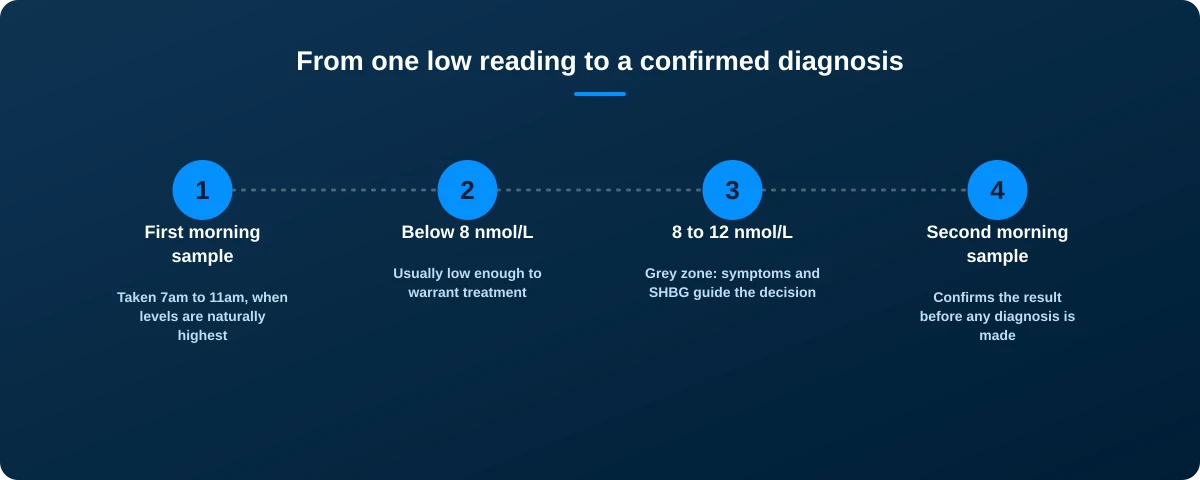
Testosterone isn't a flat, constant number: it follows a daily rhythm, highest shortly after you wake up and gradually falling as the day goes on. That's why UK guidance is specific about timing. A morning sample, ideally taken between 7am and 11am, catches testosterone near its daily peak, which is what reference ranges are built around. A sample taken in the afternoon or evening can come back lower simply because of when it was drawn, not because anything is actually wrong.
Some clinics also ask you to fast beforehand, particularly if testosterone is being checked alongside glucose or a lipid panel. Fasting isn't strictly required for testosterone on its own, but if you're having several tests at once it's worth asking your provider whether you need to arrive empty-stomached. Either way, the morning window matters more than fasting does: a result taken outside it is hard to interpret properly, whichever direction it points.
NHS test through your GP vs a private test
There are two routes to a testosterone test in the UK, and which one suits you depends on your symptoms, timeframe and budget.
The NHS route starts with your GP. If you're reporting symptoms consistent with low testosterone, such as persistent fatigue, low mood, reduced libido or difficulty with erections, your GP can arrange a morning blood test as part of working out what's going on. This is free at the point of use, but it typically means a GP appointment first to explain your symptoms, followed by a wait for a phlebotomy slot and then for the result. If your result is abnormal, follow-up and referral (for example to endocrinology) also go through the NHS waiting list, which varies a lot by area.
A private test skips the referral step: you can book a venous blood draw at a private clinic or lab, or in some cases use a home finger-prick kit, without needing your GP to request it first. Turnaround is usually faster, and many private providers pair the result with a same-week clinician review. The trade-off is cost, and the quality of the service varies between providers, so it's worth checking that any private test includes a clinician's interpretation, not just a number on a page.
Whichever route you choose, the morning timing rule above applies equally. A rushed afternoon test, NHS or private, is a wasted test.
Neither route is automatically the right one for everyone. If your symptoms are mild and you're in no rush, going through your GP first means any treatment that follows can continue on the NHS. If you want a faster answer, or your GP has already said your symptoms don't meet the threshold for NHS testing, a private test can still be the sensible next step, provided you choose a provider that gives you a proper clinician review of the result rather than just a number by email.
What the numbers mean: the 8 and 12 nmol/L thresholds
UK clinicians generally work from British Society for Sexual Medicine (BSSM) guidance when interpreting a total testosterone result:
- Below 8 nmol/L: usually considered low enough that treatment is likely to be appropriate, once a second confirmatory sample and other causes have been considered.
- 8 to 12 nmol/L: a grey zone. The result alone doesn't settle things; your symptoms, free testosterone level and SHBG (sex hormone binding globulin) all help a clinician decide whether treatment is likely to help.
- Above 12 nmol/L: generally not consistent with hypogonadism, though persistent symptoms are still worth discussing with a clinician in case something else is driving them.
Two practical points are worth knowing. First, laboratories sometimes report results in different units or against slightly different local reference ranges, so always check your result against the range printed on your own report, not just the figures above. Second, these thresholds describe total testosterone; if yours sits in the grey zone, a free testosterone calculation (which accounts for how much is bound to SHBG) often clarifies the picture further.
A common question is how testosterone levels by age should be read: should a 60-year-old expect a lower number than a 25-year-old? Testosterone does tend to decline gradually for many men as they get older, which is one reason UK reference ranges aren't split by age band the way some other tests are. In practice this means your symptoms, not where you sit relative to other men your age, are what a clinician weighs most heavily alongside the blood result itself.
Why one low result is never a diagnosis
A single low reading is a prompt to look closer, not a diagnosis on its own. Testosterone can be temporarily lowered by things that have nothing to do with long-term hypogonadism: acute illness, a poor night's sleep, obesity, and certain medicines including opioids and glucocorticoids (steroid tablets or injections) can all pull a result down for reasons that resolve once the underlying cause does.
Because of this, BSSM guidance is clear that a low result must be confirmed on a second morning sample before hypogonadism is diagnosed. If your first test comes back low, the correct next step isn't to start treatment, it's to repeat the test on another morning, ideally once any obvious temporary factor (a recent illness, a run of bad sleep) has settled.
Other tests done alongside testosterone
Testosterone is rarely checked in isolation, because the number alone doesn't explain why it's low. Alongside it, a clinician will typically also look at:
- LH and FSH (luteinising hormone and follicle stimulating hormone): these help distinguish a testicular cause of low testosterone from one originating in the pituitary gland or hypothalamus, which changes how it's managed.
- SHBG: this affects how much testosterone is "free" and biologically active versus bound and inactive, which matters most when your total testosterone sits in the 8 to 12 nmol/L grey zone.
- Prolactin: a raised level can itself suppress testosterone and points towards a pituitary cause worth investigating separately.
If treatment is being considered, a wider panel, including full blood count, liver function, lipids and PSA where age-appropriate, is also usually arranged before anything is prescribed. Our separate guide to TRT blood tests covers that fuller workup and the ongoing monitoring schedule in detail.
What happens after a confirmed low result
Once a low testosterone level has been confirmed on a second morning sample, and other causes have been considered alongside your symptoms, your clinician will discuss whether treatment is likely to help. On the NHS, this may mean a referral to endocrinology, with waiting times that vary considerably by area. Through a private UK provider, a GPhC-registered clinician can review your results and discuss options directly, which might include a topical gel, an injectable preparation, or simply continued monitoring if your picture doesn't clearly support starting treatment yet.
Whatever your result shows, it's worth remembering that a testosterone test is one piece of a wider picture, not a verdict on its own. If your level is normal but your symptoms persist, that's still worth raising with a clinician: fatigue, low mood and reduced libido have plenty of other explanations that deserve their own look, separate from the number on a lab report.